
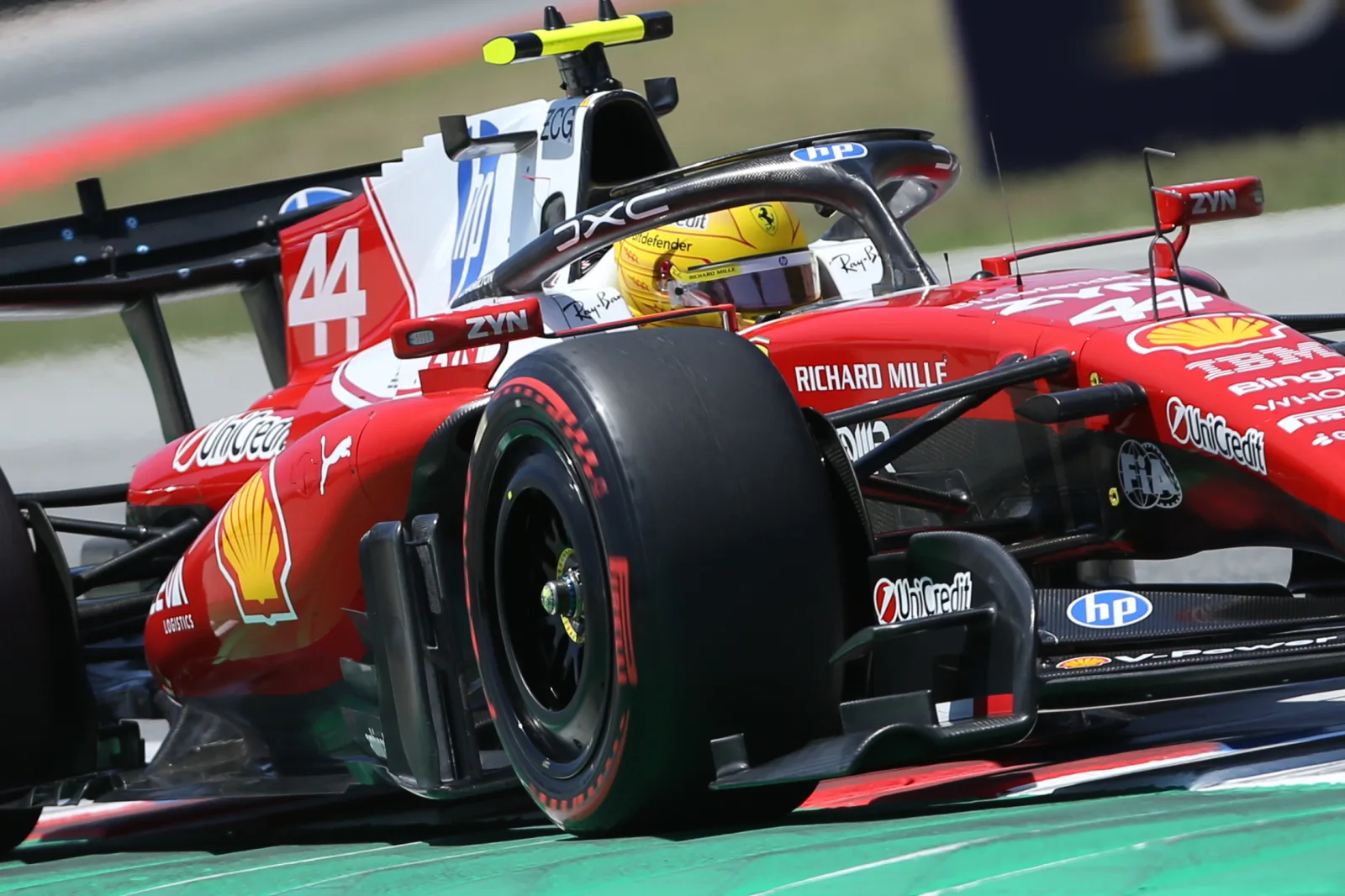
Lewis Hamilton has spent a career redefining what is possible in Formula 1, but even by his extraordinary standards, Barcelona 2026 was a level above. This was more than just another victory-it was a reaffirmation of his legacy in Formula 1, and a moment where driver, team, and timing finally converged. Ever since the announcement of his move to Ferrari, this is the moment we have all been waiting for.
At the Circuit de Barcelona-Catalunya, Hamilton delivered a commanding win-his first for Ferrari and the 106th of his career-ending a 686-day wait for victory and becoming the oldest Formula 1 winner since 1970. But beyond the numbers, this was something more telling: Ferrari were not lucky to grab this victory, they completely earned it.
A Victory Built on Belief
Hamilton could not disguise the scale of what he had achieved. This was a win that had lingered in his imagination long before its reality. "I watched Ferrari have all this success when I was younger and wondered what it would be like to win in this car," he said afterwards, his voice still carrying raw emotion. "I'm forever grateful... hopefully the first of many."
The conditions made the task anything but straightforward. With track temperatures exceeding 50°C, tyre degradation became the defining variable. Ferrari's strategy was on point for once: they rejected the conventional two-stop strategy favoured by Mercedes and committed to an aggressive three-stop plan.
It allowed Hamilton to start on the soft tyre with the aim of getting past the Mercedes of Russell at the first corner. That part of the plan didn't come to fruition, but Hamilton's early pit stop on lap 11, followed by another on lap 27, kept the pressure on the Silver Arrows. Ferrari were willing to attack the race-and crucially, their car gave them the confidence to do so.
Ferrari's Pace
For much of the early part of the season, Ferrari's pace had been discussed in theoretical terms-flashes of performance, hinted potential. In Barcelona, it became plain for all to see. Even while running behind George Russell in the opening stint, Hamilton remained within striking distance, preserving both tyres and opportunity. As the race developed, the Ferrari began to reveal its strength-particularly across longer stints where degradation punished rivals more heavily.
Once the race moved into its middle phase, Hamilton's pace became clear. He was not just maintaining pressure on the car in front - he was eroding Russell's advantage bit by bit with consistency and control.
Lap 40 provided the moment of the race. When Fernando Alonso's Aston Martin came to a halt, triggering a Virtual Safety Car, the opportunity to take his last pit stop whilst his rivals rolled around at reduced speed meant that this race was now his to lose. Hamilton dived into the pits for his final stop, emerging still in the lead-but more importantly, on fresher tyres than anyone around him.
From that moment, the race was effectively settled. What followed was clinical. Over the final 25 laps, Hamilton stretched his advantage to nearly 20 seconds, underlining the speed he had, that led commentators to note that he most likely would have been able to get past the Mercedes on worn tyres at the end of the race, even without the help of the VSC.
Remember who you are
This was not a defensive victory, nor one built on managing margins, it was assertive, dominant. "We never gave up hope," Hamilton reflected. "There were moments last year when this felt almost impossible... but we kept pushing." There had been genuine uncertainty surrounding his Ferrari move, particularly after a difficult first season where results failed to match expectation. Hamilton's pace in the final stint-on hard tyres while others struggled-was reminiscent of his most dominant periods in Mercedes machinery.
The scale of Hamilton's achievement in Barcelona is best understood in its historical context. This was his 106th Grand Prix victory, extending his record as the most successful driver in the history of the sport. It was also his seventh win at this circuit-moving him clear of Michael Schumacher as the most successful driver in Barcelona.
And at 41, he became the oldest race winner in more than five decades, a feat that underscores not just longevity, but continued brilliance. "To the fans, thank you for continuing to remind me who I am," Hamilton said after the race. Moments later, his outlook shifted forward: "There's a long, long way to go... but we're going to keep working."
The Race Behind
While Hamilton dominated the closing stages, the fight behind him told a more chaotic story.
George Russell, having converted pole into an early lead, initially appeared to control the race. But Mercedes' adherence to a two-stop plan ultimately left them exposed to Ferrari's more aggressive approach. Russell did not disguise his frustration during the race, questioning the timing of strategy calls over team radio. His eventual second-place finish reflected both strong performance and missed opportunity.
Lando Norris claimed third, securing an all-British podium-the first in Formula 1 since 1968. Further back, Max Verstappen and Oscar Piastri completed the top five, neither able to influence the fight at the front.
The most dramatic twist came from Kimi Antonelli. Having surged into contention for second, the championship leader suffered a sudden failure late in the race. He will take heart from the fact that even though Russell outqualified him, when it came to race day Antonelli was clearly a touch faster. He knows he has to focus on the things he can control and reliability issues generally even themselves out over the course of a season.
A Championship Reborn
For Ferrari, the day was both triumphant and incomplete. Charles Leclerc's race ended in frustration, the Monegasque retiring late after battling through the field. But even that setback highlighted something important: Ferrari had two cars capable of running at the front. Reliability, rather than pace, proved the limiting factor.
Barcelona may ultimately be remembered as the race that changed the trajectory of the 2026 season. Before Spain, Mercedes appeared to hold a decisive advantage. After Spain, that certainty has been eroded. Hamilton's victory reduced the gap to Antonelli and injected new life into the championship fight.
It is clear from this race that the SF-26 is fast-and not just in isolated moments. Most strikingly of all, Ferrari seemed to have out-developed Mercedes and McLaren over the past month. There are not many times in the past twenty years we've been able to say that. It will give genuine hope to the Tifosi that there may be bigger prizes to celebrate in the year ahead.
More importantly, Ferrari have demonstrated a capacity to compete across the most demanding conditions on the calendar. "We've been working so hard all year," Hamilton said. "Today is the result of all that effort."